
Brewing amount
How Much Longjing Tea Should You Use Per Cup
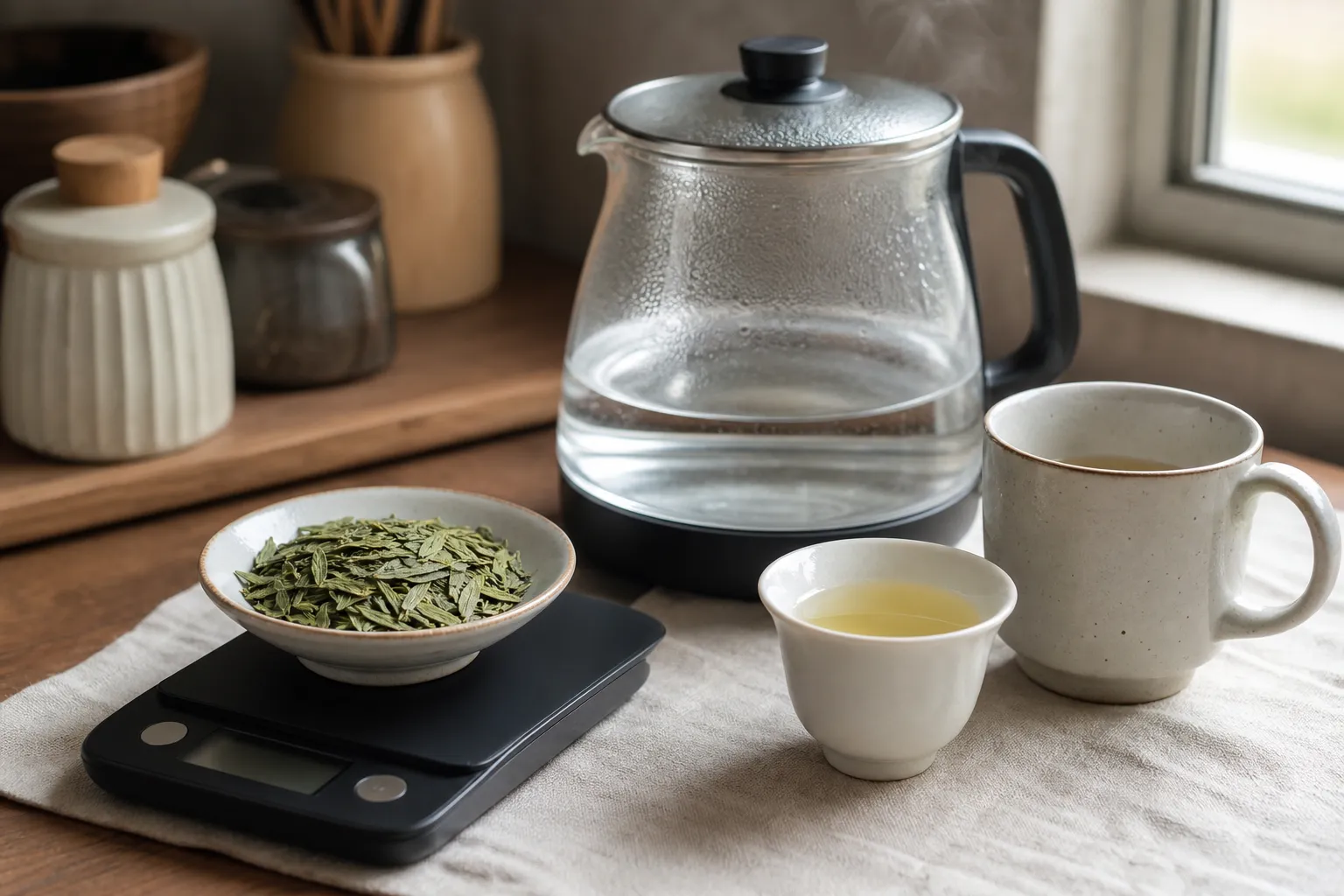
Longjing flat leaves look light in the scoop, but they can change a cup quickly. For a normal cup, start with about 2 grams of Longjing tea for 150 ml of water, or about 2.5–3 grams for 200–250 ml. Treat that as a practical Longjing tea amount per cup, not a rule carved into the leaf.
Without a scale, begin with a loose, thin layer of leaves across the bottom of the cup or brewing vessel. Use less if the tea turns bitter, drying, or too strong as it sits. Use more if the liquor tastes pale, hollow, or too quiet after a reasonable steep. The cup decides.
upward
Start with the broader guide
Use the broader guide first if you need the full scope before this page.
A Practical Starting Range
The easiest way to choose a Longjing brewing amount is to match the leaf to the water first. A small cup needs less leaf than a tall mug; a covered brewing vessel can also feel stronger than an open glass because heat and aroma stay closer to the leaves.
Small cup, about 150 ml
Starting leaf amount: about 2 g.
Best use: a light, clear everyday cup.
Medium cup, about 200 ml
Starting leaf amount: about 2.5–3 g.
Best use: a fuller cup without pushing strength too far.
Large mug, about 250 ml
Starting leaf amount: about 3–3.5 g.
Best use: more water and slower sipping.
Small gaiwan or compact vessel
Starting leaf amount: start lower, then adjust.
Best use: shorter, more concentrated pours.
These amounts are an editorial brewing starting point. The available material for this page does not support one public, source-backed Dragon Well tea leaf ratio that applies to every cup, tea, and drinker. Use the range to begin, taste, and correct.
A scale helps because Longjing leaves are flat and broad. A spoonful can change depending on how the leaves settle, how broken they are, and how tightly you load the spoon. If you brew loose-leaf green tea often, weighing once or twice can teach your eye what your usual cup needs.
Why Cup Size Changes the Answer
Longjing water volume is the first reason one person’s “right amount” tastes wrong to another person. The same leaf amount spread through more water tastes lighter; the same leaf amount held in less water tastes stronger.
For a small cup, begin near the lower end. This keeps the first sips clean and gives the leaf room to open without crowding the water. If the aroma is present but the body feels too soft, add a little more leaf next time rather than stretching the steep until the finish turns rough.
For a large mug, do not simply double the leaf unless you want a much stronger drink. More water usually needs more leaf, but large mugs are often sipped slowly. If the leaves remain in the water while you drink, the brew may keep strengthening. A moderate Longjing leaf amount can be better than a heavy one.
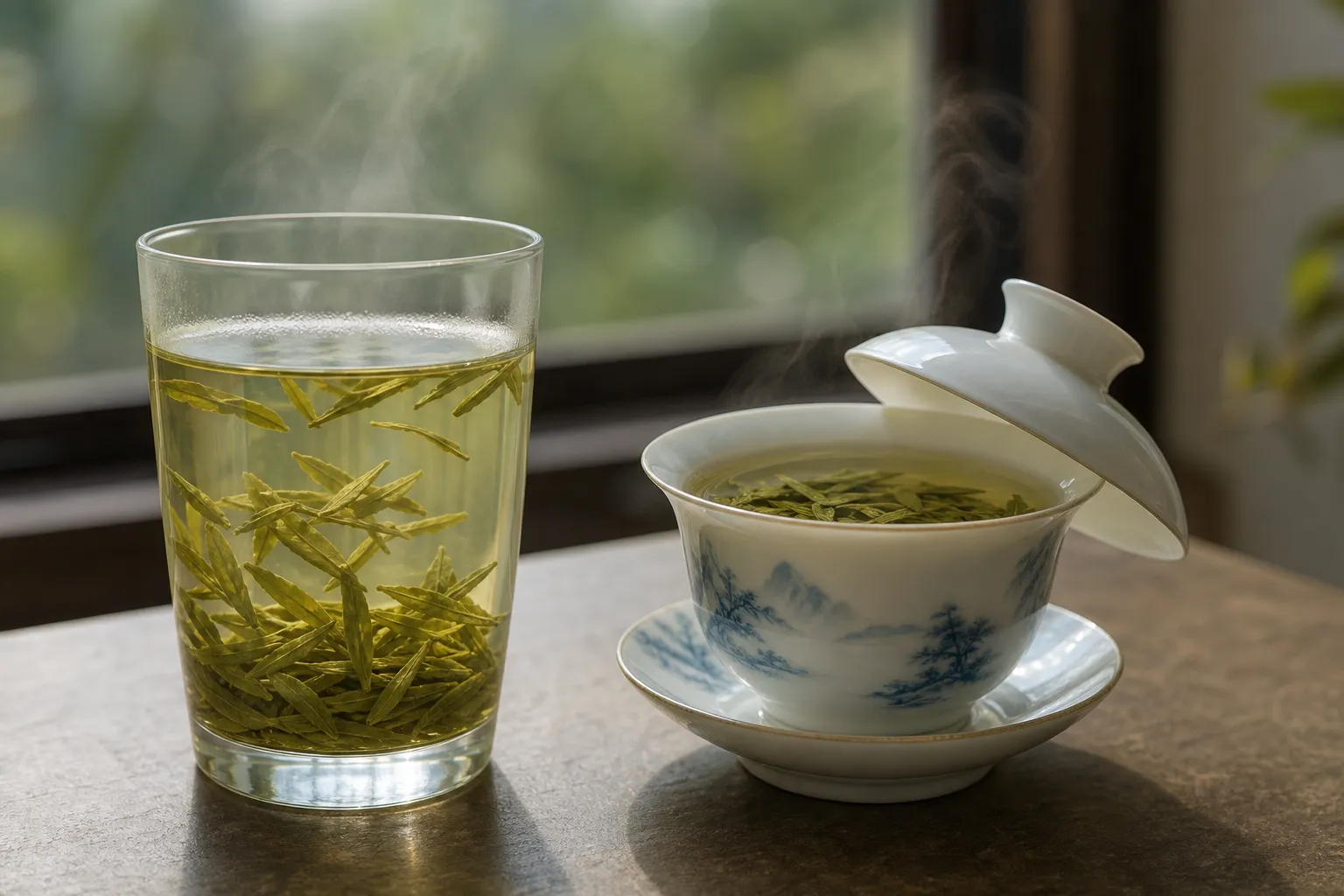
The vessel changes the feel of the same amount. An open glass lets heat and aroma escape more freely. A lidded gaiwan or covered cup keeps them closer, so the same Longjing brewing amount may taste more concentrated. Start gently in smaller vessels.
Adjust by Taste, Not by the Label
“Dragon Well,” “spring harvest,” and “premium grade” may appear in product descriptions, but those words should not decide your leaf amount by themselves. They can shape expectation; they do not prove how your specific tea will behave in your cup. Leaf condition, storage, broken pieces, water volume, and your own taste all matter.
Use the brewed cup as the check.
Bitter, drying, or sharp
The cup may be too concentrated. Use slightly less leaf next time, add more water, or shorten the contact between leaf and water. Change only one variable at a time. Longjing tea bitterness is easier to correct when the cause is not hidden.
Thin, watery, or hollow
The amount may be too low for the cup size. Add a little more leaf before you make the steep much longer. Longer steeping can add strength, but it may also pull the cup toward a rougher finish. More leaf with controlled contact is often the cleaner correction.
Flat aroma
Leaf amount is only one possible reason. Too little leaf can make the scent quiet, but old opened tea, weak storage, too much water, or a vessel that loses heat quickly can also dull the impression. Longjing flat aroma is not always solved by adding more tea.
Too strong but not especially bitter
Dilute first. Add a little hot water and taste again. That quick correction tells you whether the issue was concentration rather than the leaf itself. Keep the next cup lighter.
Brewing Style Changes the Amount
Longjing brewing style matters because leaf-to-water contact changes. A mug-style brew, where the leaves sit in the cup for a longer drink, usually needs a gentler hand. A compact vessel used for shorter pours can handle a more deliberate amount because the liquor is separated sooner.
For mug or glass brewing, begin with the moderate range and watch the leaves. If they stay in the cup while you drink, the flavor can move from soft and nutty toward stronger and more astringent. A slightly lighter Longjing tea amount per cup may be more pleasant for slow sipping.
For a small covered vessel, start conservatively until you know the tea. The first pour may show aroma quickly, and later pours can tell you whether the leaf has enough depth. If the first infusion is too soft but clean, increase the amount next time. If it is powerful immediately, keep the amount lower.
For grandpa-style drinking, where leaves remain in the cup and water is topped up, use less than you would for a controlled steep. This style is forgiving in routine but easy to overpack. A crowded cup can become dense before the leaves settle into a drinkable rhythm.
The vessel should serve the decision, not complicate it. When trying a new Longjing, use one familiar cup, one familiar water volume, and one starting amount. Change the leaf only after you know the baseline.
Common Mistakes
The first mistake is treating a ratio as proof. A Dragon Well tea leaf ratio can be useful shorthand, but it cannot promise sweetness, aroma, or smooth texture. A small starting range plus taste feedback is more useful than a number that sounds exact but ignores the cup.
The second mistake is measuring only by teaspoons. Longjing leaves are not shaped like rolled pellets or fine broken tea. Their flat form makes volume measurements uneven. One teaspoon may hold a loose scatter of intact leaves; another may hold smaller fragments that brew more heavily. Weight is clearer when precision matters.
The third mistake is blaming the amount for every problem. Bitterness may come from too much leaf, but heat, time, and long leaf contact can also push the cup. Thinness may come from too little leaf, but it may also come from weak tea, too much water, or a brewing style that does not suit the leaf. Amount is one lever.
Market language can distract from the cup. A package may describe Longjing Dragon Well in attractive terms, but your brewing decision still begins with water volume and taste feedback. A sourcing cue is useful when it helps you notice the leaf more clearly. It should not replace tasting.
A Simple Correction Method
When a cup is close but not quite right, adjust in small steps:
- If it is too bitter, reduce the leaf amount slightly or use more water.
- If it is too thin, add a little more leaf before extending the steep.
- If it is too strong, dilute the brewed liquor and start lighter next time.
- If the aroma is flat, check storage and water volume before blaming the amount.
- If each cup changes too much, measure the water and leaf once to reset your baseline.
Small changes work better than dramatic ones. Longjing can lose its balance when the cup swings from under-leafed to crowded. A half gram can be noticeable in a small vessel; a modest pinch can matter in a mug.
Keep notes only if they help. “3 g in my mug was too strong” is enough. “2.5 g tasted clear but light” is enough. The goal is not a lab record; it is a repeatable cup.
The Boundary on Precision
There is no single Longjing leaf amount that fits every cup, every tea, and every drinker. The available material for this page does not support one exact Longjing grams per cup number as authoritative. Overly precise tea advice can sound more certain than the evidence allows.
The useful answer is still practical: start around 2 g for a small cup, around 2.5–3 g for a medium cup, and around 3–3.5 g for a larger mug. Then adjust by water volume, vessel, and taste. Keep the first correction small.
For your next cup, choose one vessel and one water volume. Measure the Longjing once, taste carefully, and change only the leaf amount next time. The leaf will make the answer clearer.