
Practical culture map
Green Tea Culture
A flat Longjing leaf, a cloudy bowl of matcha, a pale sencha cup, or the first sharp sip can all lead to the same question: what does green tea culture actually include?
Green tea culture is not one ritual, one country, one flavor, or one wellness promise. It is the practical world around green tea: how leaves and powders are grown, chosen, prepared, served, tasted, stored, described, and folded into daily life. The useful starting point is observable: leaf shape, aroma, liquor color, bitterness, sweetness, texture, and how the cup changes when water temperature or steep time changes.
Culture gives those observations a setting. It can explain why a tool matters, why a serving habit feels careful, or why a famous name carries weight. It does not automatically prove quality, origin, freshness, or personal benefit. Read the leaf before the claim.
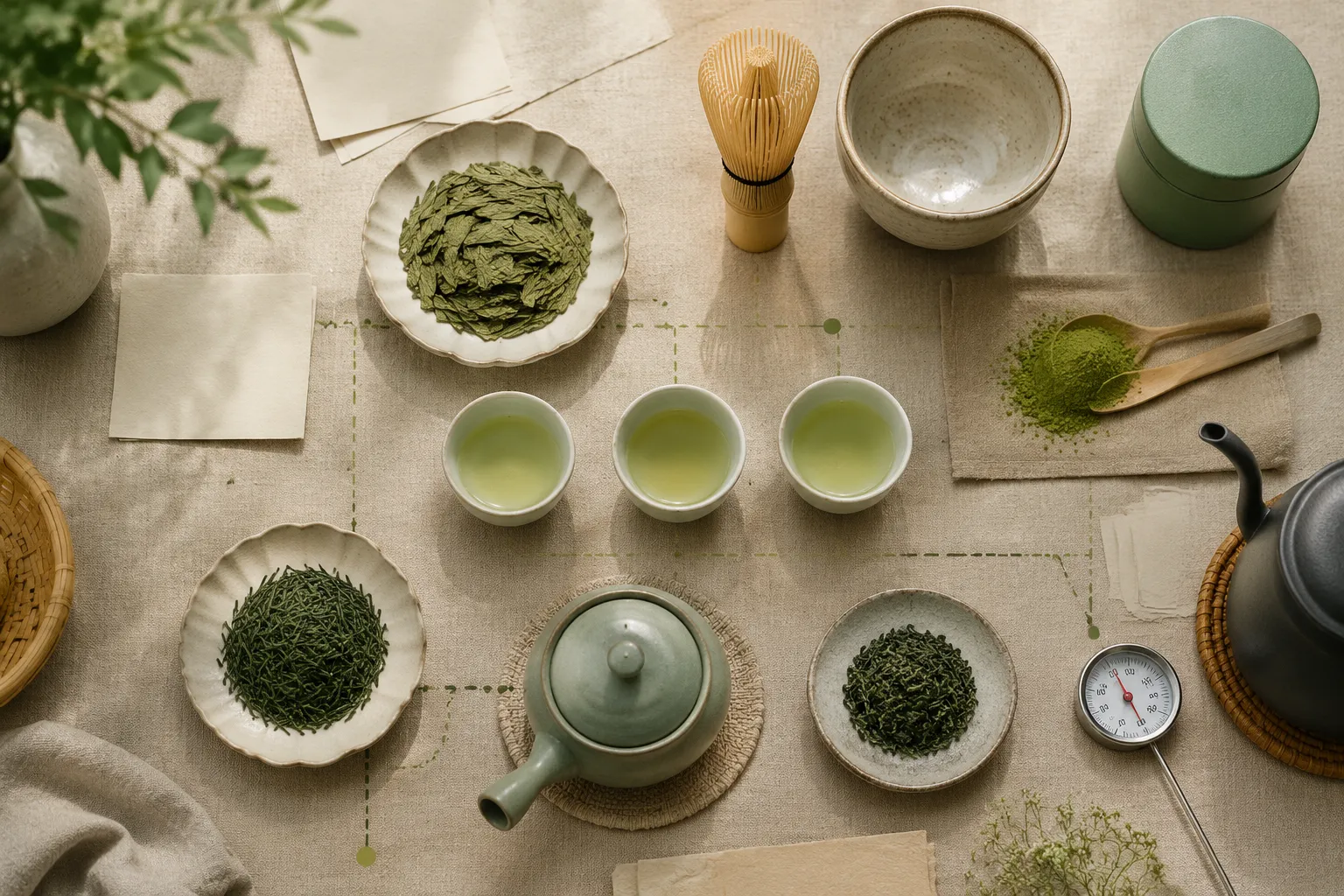
What Green Tea Culture Covers
Green tea culture is best understood as a map of habits and meanings around green tea. For a reader, that map should answer a practical question: which part of the tea should I pay attention to next?
A package may mention origin, tradition, grade, ceremony, harvest, antioxidants, freshness, or energy. Some of those words can help you ask better questions. None of them should replace direct observation in the cup.
Leaf and cup
Look first at shape, color, aroma, and texture. This helps with taste expectations and brewing adjustment, but it cannot prove overall quality or exact origin by itself.
Preparation
Look at water, time, leaf amount, and tool. This helps with bitterness, body, aroma, and repeatability, but it does not create one universal method for every tea.
Cultural context
Chinese and Japanese tea settings can explain why different tools, words, and habits appear. They do not create a single fixed meaning for every drinker.
Variety and style
Longjing, matcha, sencha, and loose-leaf examples help readers choose a narrower path, but a famous name is not automatically better.
Sourcing language
Origin, harvest, grade, and producer wording can support better buying questions, but they are not full proof without stronger support.
Daily use
Caffeine, routine, and general wellness interest help set sensible expectations, but they do not support health-outcome certainty.
A root page should not turn every lane into a full sub-guide. Its job is to show the main paths clearly enough that the next question becomes easier.
Start With the Cup, Not the Claim
A green tea claim can sound convincing before water ever touches the leaf. The cup is slower and more useful.
Dry leaves may look flat, curled, broken, needle-like, powdery, or mixed. The brewed liquor may be pale, yellow-green, deeper green, cloudy, or clear. The aroma may seem grassy, toasted, marine, nutty, floral, vegetal, or muted. The first sip may feel sweet, brisk, bitter, savory, drying, soft, or thin.
Those observations do not require grand language. They give you a way to compare one tea with another and one brew with the next.
A short observation sequence
- 1. Look at the dry leaf or powder before brewing.
- 2. Smell it before adding water.
- 3. Notice the water temperature and steep time.
- 4. Watch the liquor color or matcha texture.
- 5. Taste for sweetness, bitterness, body, and aftertaste.
- 6. Adjust only one variable in the next cup.
If the cup is sharp and bitter, hotter water or a longer steep may be part of the reason. If the aroma feels flat, storage, age, leaf condition, or preparation may be involved. The cup will not answer every sourcing question, but it can show what needs attention next.
Taste words should stay modest. “Nutty,” “grassy,” “umami,” “toasted,” or “fresh” can help when they point back to something a drinker can check. They become less useful when they are treated as proof of origin, grade, or wellness value.
A stronger tasting note is simple and limited: “The second steep was less bitter after a shorter infusion.” That gives you a next action. Water and time speak clearly.
Chinese and Japanese Green Tea Culture as Reader Paths
Chinese tea culture and Japanese tea culture are often the first two broad doors readers notice. This page treats them as orientation paths, not complete histories. The supplied material for this article does not include citable cultural sources, so the safer approach is to use these paths to organize reader questions rather than make detailed claims about ritual, chronology, or authority.
The practical difference for a beginner is not that one culture is better or more traditional. It is that different settings tend to lead readers toward different questions: loose-leaf appearance, serving style, tools, hospitality, matcha preparation, sencha habits, ceremony language, everyday drinking, and the role of origin words.
Chinese green tea culture
Ask what the dry leaf looks like, whether the tea is described through a place name, style name, harvest term, or broad category, and what brewing vessel or serving habit is suggested. A tradition can give context, but the name alone is not a complete quality judgment.
Japanese green tea culture
Ask whether you are brewing loose leaves or whisking powder, whether the setting is daily drinking, formal meaning, or market language, and what can be observed in the cup or bowl. Matcha, sencha, and ceremony language should not be collapsed into one meaning.
Longjing tea tradition
Ask whether “Longjing” is being used as an origin claim, a style cue, a taste expectation, or a selling point. Flat leaves tell only part of the story.
Matcha ceremony meaning
Ask whether the question is about tools, gestures, hospitality, quiet attention, or everyday preparation. Matcha foam is a preparation signal, not a cultural shortcut.
Sencha habits
Ask how leaf amount, water temperature, steep time, and vessel shape change sweetness or bitterness. If the first cup tastes too sharp, test preparation before judging the tea.
This kind of map keeps cultural language useful. It lets a reader ask better questions without pretending that every term has one fixed meaning.
Major Green Tea Forms Without Turning Them Into a Catalog
Green tea culture becomes easier to navigate when every name is not treated as a separate world. A root page only needs enough structure to help you choose the next reading path.
Loose-leaf green tea
First cue: leaf shape, aroma, and color after steeping. Useful question: how do water temperature and time change the cup?
Longjing Dragon Well
First cue: flat leaves and origin-linked language. Useful question: what does the tradition suggest, and what still needs support?
Sencha
First cue: leaf appearance, aroma, and brewed color. Useful question: how does Japanese green tea culture frame daily drinking?
Matcha
First cue: powder texture, color, foam, and mouthfeel. Useful question: what does ceremony language add, and what is everyday preparation?
Blended or flavored green tea
First cue: added ingredients and aroma. Useful question: am I tasting the tea base, the flavoring, or both?
Bottled or ready-to-drink green tea
First cue: label, sweetness, and storage condition. Useful question: is this a tea culture question or a beverage category question?
This prevents a common mistake: assuming that a famous style, a ceremonial word, or a regional name tells the whole story. It may tell you where to look. It does not finish the evaluation.
Longjing deserves a deeper path because readers often meet it through several signals at once: a place name, flat leaf appearance, harvest language, processing vocabulary, serving customs, and reputation. At root level, the better question is what the word “Longjing” is doing in the description. Is it naming a style, making an origin claim, setting a taste expectation, or adding prestige? Each use needs a different kind of support.
Matcha raises a different kind of question. The word “ceremony” can make a simple bowl of powdered tea feel larger than it is. Some readers want cultural meaning; others want to know whether ceremony language is required for daily matcha. It is not useful to collapse those questions. For everyday drinking, start with powder texture, water temperature, whisking, foam, bowl shape, and mouthfeel. For formal meaning, look for careful sources before making strong statements.
Sencha usually brings the reader back to a practical cup: leaves, water, steep time, aroma, sweetness, bitterness, and a small teapot or other brewing vessel. Sencha sweetness changes with water and time.
Brewing Habits Are Culture in Practice
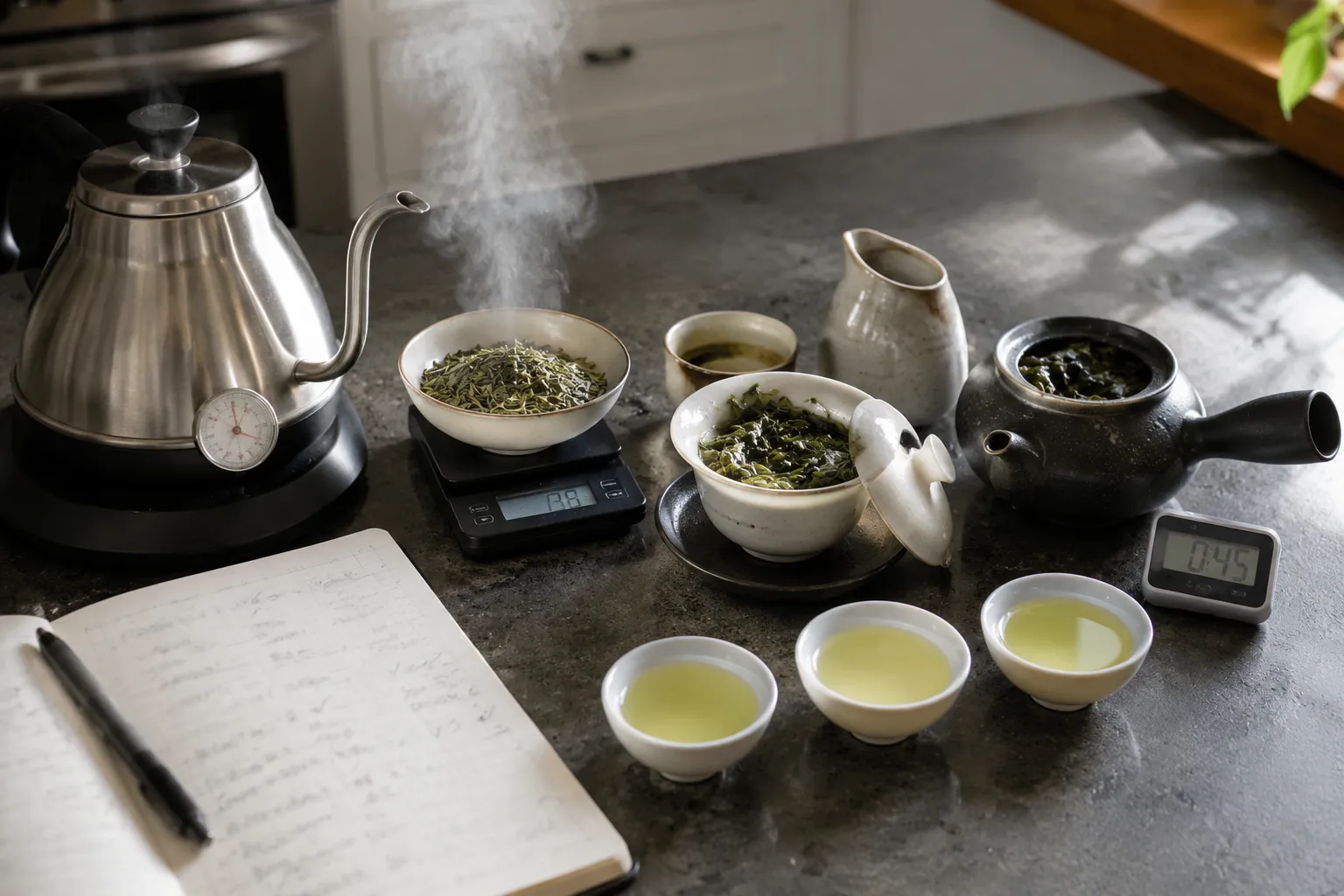
Green tea brewing habits show culture at the level of hands and tools. A gaiwan, kyusu, matcha bowl, whisk, glass cup, mug, strainer, or storage tin changes how the drinker pays attention. Some tools make leaf movement visible. Some make repeat infusions easier. Some emphasize foam, texture, or serving rhythm.
The safest claim is also the most useful one: brewing choices change the cup. Water temperature, steep time, leaf amount, vessel size, and number of infusions can shift bitterness, aroma, body, and color. You do not need one correct method for every tea.
Water temperature
Changes bitterness, aroma lift, and body. Lower it if the cup turns harsh; raise it carefully if the tea tastes thin.
Steep time
Changes strength, astringency, and aftertaste. Shorten if the finish dries the mouth too much.
Leaf amount
Changes concentration and texture. Use less leaf for a softer cup; more leaf for a denser one.
Vessel
Changes heat retention and leaf movement. Choose a tool that lets you repeat the method.
Infusion count
Changes the flavor sequence. Notice whether later cups soften, fade, or become rough.
These are not ceremonial rules. They are repeatable points of attention. If you change all five at once, you learn less. Let the kettle explain the bitterness.
Serving tea to someone else adds another layer. The host chooses the leaf, vessel, temperature, cup size, pace, and amount of explanation. That may happen at a kitchen table, in a tea room, at a shop counter, or in a more formal setting. The meaning depends on context.
A useful host does not need exaggerated claims. A simple sentence can be enough: “This one becomes sweeter with a shorter steep,” or “This matcha is prepared for texture rather than foam height.” Hospitality can be practical.
Tea Terroir Explained Without Overclaiming
Tea terroir is a word readers often meet when green tea descriptions mention region, elevation, climate, cultivar, soil, harvest season, or processing. At root level, tea terroir explained should begin with a boundary: origin language can guide questions, but it does not prove the final cup on its own.
A region name may suggest a tradition, style, or expectation. A harvest term may suggest seasonal framing. A producer description may point toward field, cultivar, processing, or handling. But none of those signals should be treated as complete proof without better support.
Use terroir language as a question set
- Does the description name a place clearly?
- Does it connect the place to leaf style, harvest timing, or processing?
- Does it explain what the origin is expected to change in the cup?
- Is the same origin word being used as geography, style, reputation, or marketing?
- Can the claim be checked through documentation or direct comparison?
This is where a reader should slow down. A sourcing cue is not a quality verdict. It is a starting point.
Origin also has limits. It cannot tell you how the tea was stored after purchase. It cannot tell you whether your water is too hot. It cannot tell you whether a tea was brewed well in your cup. It also cannot replace careful sourcing support when the claim matters.
That does not make origin irrelevant. It makes origin one piece of the map. Taste the cup, read the label, ask what the word is meant to show, and keep the claim proportional.
Sourcing Cues for a Better Green Tea Purchase
Green tea sourcing cues are useful because many buyers face the same problem: the package says a lot, but not all of it helps. Some words describe visible features. Some describe cultural context. Some describe market position. Some ask for trust without giving much to inspect.
A careful buyer reads in layers
- 1. Visible tea form: loose leaf, powder, bagged tea, blend, or ready-to-drink product.
- 2. Leaf or powder condition: shape, color, brokenness, aroma, clumping, or dustiness.
- 3. Preparation fit: whether the tea suits the way you actually brew.
- 4. Origin wording: place names, style names, or vague regional language.
- 5. Harvest or grade language: useful only when explained and supported.
- 6. Storage condition: packaging, seal, light exposure, and freshness cues.
- 7. Claim discipline: whether the description stays with taste and preparation or reaches beyond what it can show.
This stack does not require suspicion. It gives the reader a way to slow down. A tea can be enjoyable even when the package is modest. A dramatic label can still leave basic questions unanswered.
Words such as premium, ceremonial, rare, estate, handmade, fresh, or high grade may appear in green tea descriptions. Some may be meaningful in the right context. Some may be loose market language. Without stronger support, this root page treats them as prompts for questions rather than proof.
Ask what the word changes. Does it explain leaf appearance? Does it tell you how to brew? Does it name a verifiable source? Does it describe taste in a way you can check? If not, return to the cup.
Storage Is Part of Green Tea Culture Too
A good green tea can become less expressive if it is handled poorly after purchase. Storage is not glamorous, but it is one of the clearest everyday decisions a drinker can make. Heat, light, air, moisture, and strong odors are common enemies of delicate tea character; the practical response is a sealed container, a cool place, and careful handling.
The supplied material for this article does not provide detailed storage studies or product-specific guidance, so this section stays general. The useful point is simple: storage cannot make a stale tea fresh again, but poor storage can make a promising tea harder to enjoy.
When green tea tastes flat, dull, cardboard-like, or oddly scented
- Was the tea stored near spices, coffee, soap, or cooking odors?
- Was the package left open between uses?
- Did the leaves or powder sit in direct light?
- Did moisture enter the container?
- Has the aroma changed since opening?
- Is the tea being judged by an old package rather than a recent cup?
Matcha powder and loose-leaf tea may raise different storage questions, but the reader task is the same: protect aroma and reduce avoidable damage. A storage tin is a flavor decision.
Wellness Context Without Turning Tea Into a Promise
Green tea wellness context is part of modern reader interest, especially around caffeine, focus, energy, and antioxidants. This page keeps that language cautious. Green tea contains caffeine, and many drinkers describe different feelings from different cups, but personal response varies. Antioxidant language belongs in general nutrition context, not in outcome promises.
If a reader has health concerns, medication questions, pregnancy-related questions, caffeine sensitivity, or a reason to limit stimulants, a tea article is not the right authority to settle that decision. Qualified medical guidance is the better path for higher-stakes choices.
The cleanest boundary is to separate sensory observations from body claims. A cup can taste brisk. A tea can feel strong on the palate. A matcha can have a dense texture. A sencha can seem vivid when brewed with care. Those are cup-level observations.
They are not the same as guaranteed mental or physical results. A modest sentence is safer and more useful: some drinkers prefer green tea when they want a lighter caffeine routine than coffee. Even that should remain personal, not universal.
Caffeine matters because it affects routine. A morning cup, an afternoon sencha, and a bowl of matcha may fit differently into a person’s day. The exact experience depends on the tea, amount, preparation, and the drinker.
For most readers, the practical question is not what the tea will do to them. It is when they drink it, how strong they make it, and how they feel afterward. Track the cup, not the slogan.
Common Misreadings of Green Tea Culture
Green tea culture becomes confusing when cultural words, market words, and wellness words are treated as the same kind of evidence. They are not. A tradition can provide context. A label can provide clues. A cup can provide sensory feedback. None should be stretched beyond its role.
Tradition automatically means better tea
Tradition can make a tea more interesting to study, but it does not replace cup quality, storage condition, or sourcing support.
Ceremony language is required for matcha
Formal settings can give matcha cultural meaning, while daily matcha preparation can stay simple and practical.
Origin words settle quality
Place is a clue, not the whole cup; ask how the tea was processed, stored, described, and brewed.
Bitter means bad
Bitterness can come from the tea, water, steep time, leaf amount, or preference; adjust before deciding.
Wellness words prove personal results
Taste, routine, caffeine tolerance, and stronger health claims should stay separate.
A calm cup is still a cup.
Where to Go Next
The best next page depends on the question that brought you here. Use these child topics as entry points rather than as full answers inside the root page.
Chinese Green Tea Culture
For questions about how Chinese tea habits connect leaf, origin, and daily drinking. This path should clarify leaf appearance, brewing habits, hospitality, and the limits of tradition as proof.
Japanese Green Tea Culture
For questions about how sencha, matcha, daily tea, and ceremony language are separated. This path should clarify everyday preparation, formal meaning, tools, and drinker expectations.
Longjing Tea Tradition
For questions about why Longjing carries cultural weight. This path should clarify place language, harvest cues, flat leaves, serving customs, and sourcing caution.
Matcha Ceremony Meaning
For questions about what ceremony language means for modern matcha. This path should clarify tools, gestures, quiet attention, hospitality, and daily-use boundaries.
Tea Terroir Explained
For questions about what origin really tells a green tea buyer. This path should clarify region, climate, cultivar, processing language, and what origin cannot prove alone.
A root page should leave room for those deeper paths. Its job is to show which door matches the reader’s present question.
A Practical Green Tea Culture Framework
When you meet a new green tea, use a simple sequence before reading too much into the label.
First, identify the form
Is it loose leaf, powder, bagged tea, a blend, or a ready-to-drink product? Form changes the question. Loose leaf invites attention to leaf shape and infusion. Matcha asks about powder, whisking, foam, and texture. A bottled drink raises label and ingredient questions more than brewing questions.
Second, brew with one clear variable
Choose a method and make it repeatable. If the first cup is too bitter, change steep time or water temperature next. If it is too thin, adjust leaf amount or time. One change teaches more than five guesses.
Third, read cultural language as context
Chinese green tea culture, Japanese green tea culture, Longjing tea tradition, and matcha ceremony meaning can all deepen the experience when they explain a practice, tool, serving habit, or tasting expectation. They should not be used as shortcuts around evidence.
Fourth, treat sourcing words as questions
Origin, grade, harvest, estate, and style language can be helpful. Ask what each word is meant to show. If it matters, look for stronger support than a decorative phrase. If it does not affect your decision, let it stay in the background.
Fifth, protect the tea after buying
Storage is not separate from culture; it is part of respect for the leaf. Keep the tea sealed, away from strong odors, and protected from avoidable heat, light, and moisture. Then judge it by a fresh brew, not by a tired package.
Finally, keep wellness language proportional
Caffeine and antioxidant context may matter to readers, but green tea should not be turned into a health outcome claim. Notice your own tolerance, keep serving size and timing in mind, and use professional guidance when the question carries personal health stakes.
The cup can support a routine. It should not carry a promise.
Evidence Boundary
This article uses source-aware boundaries rather than unsupported certainty. No public reference links were available in the supplied research set for detailed cultural history, terroir claims, storage studies, caffeine ranges, antioxidant discussion, or formal ceremony explanation. For that reason, the page keeps its claims practical: visible leaf and cup cues, preparation choices, sourcing questions, storage habits, and cautious wellness context.
Future deeper pages should use stronger cultural, agricultural, institutional, or nutrition sources where the claim requires them. This root page stays with what a reader can observe and what a careful next question should be.
The Short Answer to Green Tea Culture
Green tea culture is the practical and cultural world around green tea: how leaves and powders become meaningful through preparation, serving, origin language, sensory attention, storage, and daily use. Chinese and Japanese paths give readers different ways to ask about tools, hospitality, tradition, matcha, sencha, Longjing, and terroir. Those paths are valuable when they help you observe more carefully.
The safest way to enter is also the most useful: look at the leaf, brew with attention, taste before judging, read sourcing words with care, store the tea well, and keep wellness language modest. The next cup does not need a grand claim. It needs one clear observation: leaf, water, time, aroma, bitterness, or sweetness.