
How Longjing Tea Is Served to Guests
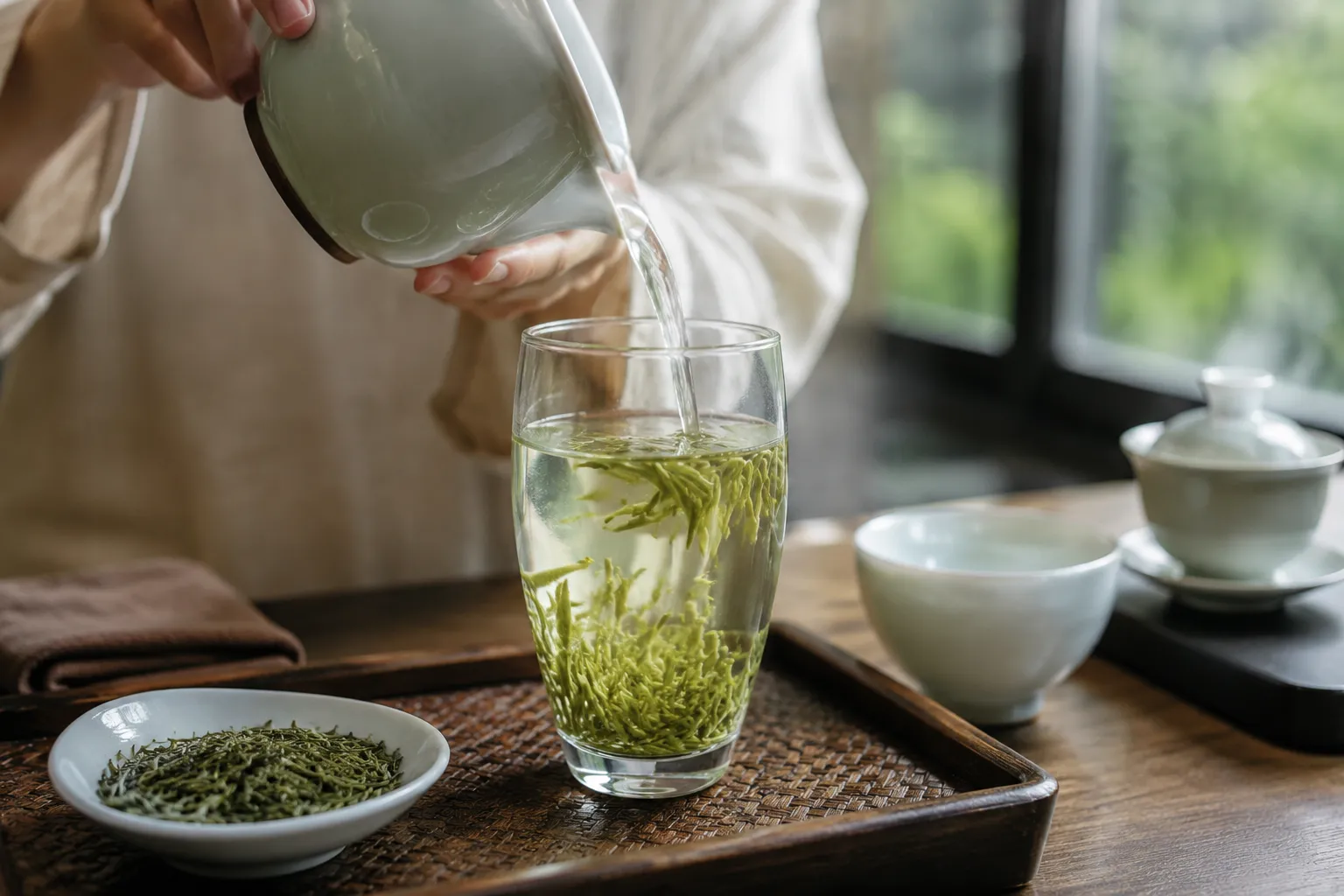
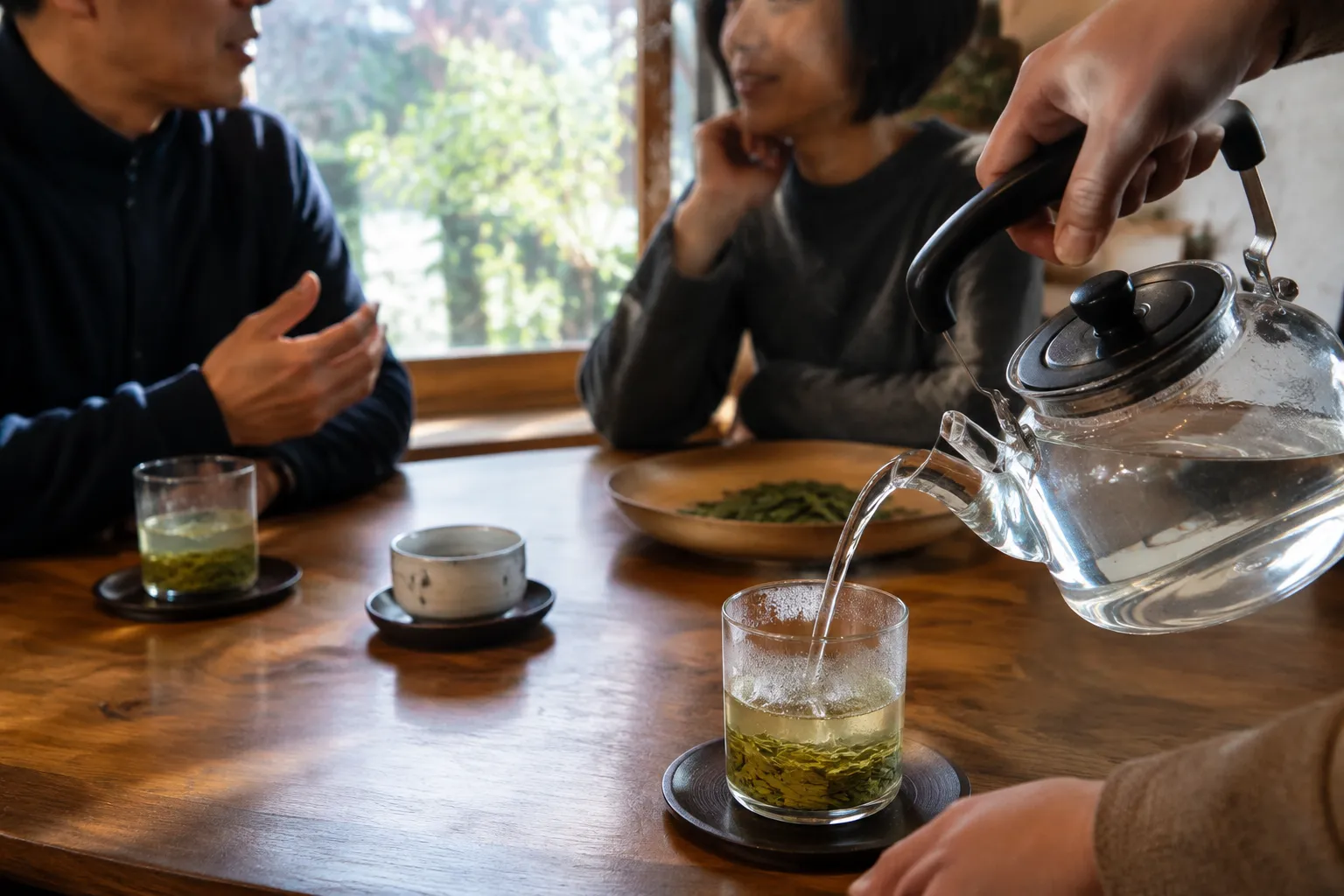
Longjing is often served to guests in a way that looks modest before it looks formal: flat green leaves go directly into a clear glass or plain cup, hot water is poured over them, and the leaves stay visible while the guest drinks. In many Hangzhou tea settings, the host watches the cup and adds more hot water over the same leaves as the conversation continues.
That is the practical center of the Longjing tea serving tradition: welcome, attention, and shared time. It is not one fixed performance. The vessel, water temperature, filling level, and gestures around the table can shift by host, household, tea house, and occasion.
upward
Start with the broader guide
Use the broader guide first if you need the full scope before this page.
What the Guest Usually Sees First
The first clue is often the leaf. Longjing Dragon Well is known for its flattened leaves, and a clear glass turns those leaves into part of the service. They float, open, tilt, sink unevenly, and make the tea easy to watch.
That visible-leaf style changes the drinking experience. The tea is not always strained before it reaches the guest. You may sip while the leaves remain in the cup, pause when they gather near the rim, or wait a moment for them to settle. If you are used to a teapot, infuser basket, or fully filtered cup, this can feel unusual at first.
The water is usually handled gently. Visitor accounts and common brewing advice often describe Longjing with water below a hard boil, sometimes around 80 C / 175 F. The available material does not support one strict temperature rule for guest service, so the better reading is practical: hot enough to open the leaf, not so forceful that the cup turns harsh at once.
The first pour does not need to be dramatic. A host may add leaves, pour water, let the leaves move, and offer the glass with little explanation. The cup does much of the telling.
Visible leaf
Flat Longjing leaves may remain in the cup while the guest drinks.
Gentle water
The water is commonly described as hot but below a hard boil, without one fixed guest-service rule.
Quiet offer
The host may let the glass, leaf movement, and aroma carry the welcome.
Refills Are Part of the Hospitality
Hot water refills are one of the clearest signs of Hangzhou tea hospitality. Instead of replacing the leaves after one drink, a host may add more water over the same Longjing leaves as the guest drinks down the glass. Later pours usually taste softer, but the service continues.
The refill is also social. The host notices whether the cup is low, whether the tea is still comfortable to drink, and whether the guest seems settled. A refill can quietly say that there is no hurry.
The cup is not always filled to the brim. Broad Chinese tea-etiquette material often treats overfilling as careless, but the Longjing-specific evidence is not strong enough to make that a fixed Hangzhou rule. It is safer to understand the habit in practical terms: leaving space makes a hot cup easier to hold, easier to sip, and less likely to spill when leaves are still floating.
For the guest, the response can stay simple. Let the host refill unless you need to decline, drink at a relaxed pace, and do not treat the leaves in the glass as a mistake. In this style of serving Dragon Well tea, the leaf is meant to remain visible.
The Quiet Etiquette Around the Cup
Longjing guest tea is better understood as attentive hospitality than as a ceremony manual. A host may serve it to family, friends, visitors, or customers in a tea house. The shared idea is warmth and respect, but the expression can be plain.
One small gesture some guests may see is the two-finger table tap. In Chinese tea settings, lightly tapping two fingers on the table can work as a quiet thank-you when someone pours or refills tea. It is useful to recognize if people around the table use it. It should not be treated as mandatory Longjing guest etiquette in every home, tea house, or casual setting.
Receiving the cup with care also fits the mood. In a more formal setting, or when an older host is serving, accepting tea with both hands may feel appropriate. At a tea stall or household table, the main point is not theatrical precision. Face the cup, acknowledge the pour, and treat the tea as part of the welcome.
The host's role is quiet too. Attention may show through refilling water, adjusting the pace, offering more tea without pressure, or letting the guest simply drink. Dragon Well hospitality tea can matter socially without becoming elaborate.
Why Clear Glass Service Is So Commonly Mentioned
Clear glass appears often in descriptions of Longjing because it suits the tea's visible form. The flat leaves can be seen as they hydrate, and the pale green-yellow liquor is easy to judge by eye. For a guest, this makes the tea immediate: leaf, water, color, aroma, sip.
That does not mean every proper serving must use glass. A simple cup, lidded bowl, teapot, or other vessel may appear depending on the host and setting. Retailer brewing advice often recommends several tools for Chinese green tea, including a gaiwan or small teapot, but general brewing advice should not erase the common Hangzhou image of Longjing in clear glass.
The glass also explains why the tea may be left unstrained. If the leaves are part of what the host wants the guest to notice, filtering them out changes the experience. The guest sees the leaf shape, watches the steeping, and understands the tea as loose-leaf rather than a hidden infusion.
Evidence boundary
Leaf shape and clear-glass service do not prove origin, grade, or producer honesty. Longjing is strongly associated with Hangzhou and West Lake culture, and public cultural sources support that local setting, but a served cup alone cannot verify a label or vendor claim. Taste and appearance can guide attention; they cannot do paperwork.
What Changes From Place to Place
A household cup, a tea-house glass, a tea-stall serving, and a visitor tasting near a tea village may all feel different. The common thread is often the gesture of welcome, but the details shift.
In a home, the service may be plain: leaves, water, refills, conversation. In a tea house, the pouring may be more practiced, and the guest may sit longer with repeated water additions. In visitor-facing settings around Hangzhou, Longjing may be presented with cultural explanation, tastings, or demonstrations. Those public settings can help a traveler understand the tea's local importance, but they do not prove that every private host follows the same sequence.
Season can also shape the story around the cup. Longjing is often discussed through spring harvest language, including terms connected with Qingming and early-season tea. Those words may appear in shops and tastings, but they are not needed to understand guest service. A host does not need to give a harvest lecture for the tea to function as hospitality.
Water can become part of the cultural frame too. Hupao Spring water is a well-known West Lake pairing in Longjing culture. Still, it is background context, not a requirement for serving a guest. Most guests are simply being offered tea with the water available to the host.
Common Misreadings
Expecting a fixed ceremony
Longjing can be prepared with care, but the glass-based style described in many Hangzhou-facing observations is more relaxed than a formal Gongfu Cha-style sequence.
Reading tourism language as rules
Travel and hotel phrases about refined living, premium tea, or traditional experience are not reliable evidence for one universal serving rule.
Assuming one required vessel
A pot or lidded vessel may be valid, but it is not the only way a guest may receive the tea in Hangzhou.
Turning serving into wellness
Longjing is green tea and contains caffeine, but a cup offered to a guest should not be read as a promise about alertness, antioxidant effects, or any body outcome.
The Evidence Limit
The strongest public material supports Hangzhou's deep tea-culture setting, Longjing's association with West Lake, tea villages, public tastings, museum interpretation, utensils, and customs. It does not establish one complete household rulebook for how every host serves Longjing to guests.
The most direct serving details come from limited visitor observations and weaker market or social material: leaves placed directly in a clear glass, leaves left in the vessel, hot water poured over them, later refills, quiet thanks, and careful cup handling. Those details are useful because they match the visible cup a reader may actually encounter. They should be phrased as common, observed, or likely in many settings, not as compulsory etiquette.
So the practical answer stays narrow: if Longjing is served to you as guest tea, expect visible leaves, gentle hot water, possible refills, and understated thanks. Watch the cup before looking for a ceremony. The leaf tells you how to drink.
FAQ
Is Longjing always served in a clear glass?
No. Clear glass is common in descriptions because it shows the flat leaves and pale liquor, but Longjing can also be served in other simple vessels. The glass is a useful reference point, not a rule.
Should I remove the leaves before drinking?
Usually not if the tea is served directly in the cup. Let the leaves settle, sip around them, and pause if they drift toward the rim. The unstrained leaves are part of the style.
What should I do when the host refills my cup?
Acknowledge the refill quietly. If others use a two-finger table tap, you can follow that gesture, but a simple thanks or attentive pause is enough in many casual settings.
Does the serving style prove the tea is West Lake Longjing?
No. A clear glass, flat leaves, pale liquor, or fresh aroma can make the tea worth noticing, but they cannot verify origin or grade. Provenance depends on sourcing records and seller honesty, not the cup alone.
Sources
Sources and further reading
Reference links are limited to sources considered suitable for public citation in this page.