
Dragon Well claim check
Common Misconceptions About Dragon Well Tea Culture
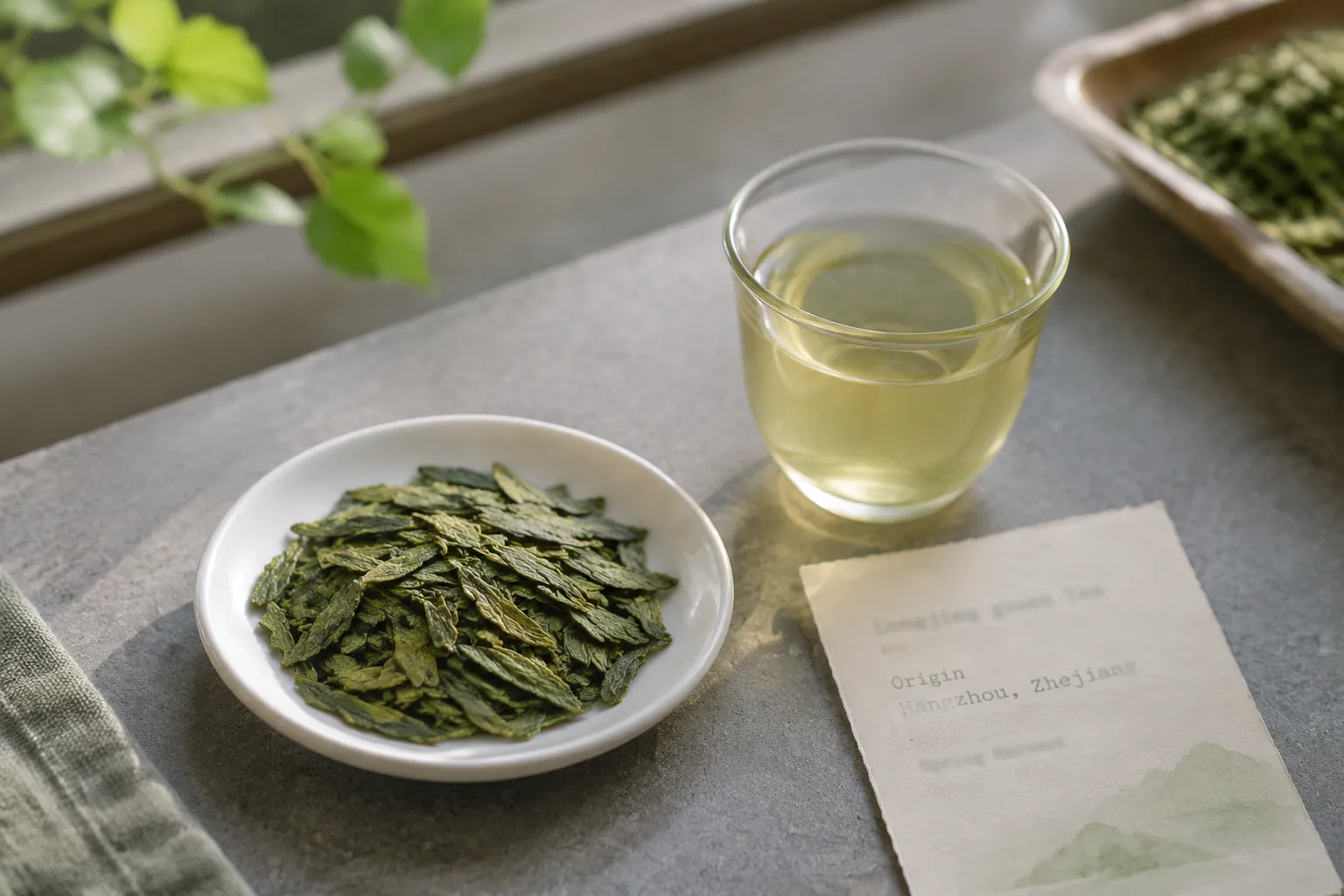
Flat Longjing leaves, a pale yellow-green cup, and a soft chestnut-like aroma can tell you something useful about the tea in front of you. They cannot carry every claim attached to Dragon Well. The clearest answer to Dragon Well tea culture misconceptions is this: Dragon Well and Longjing are commonly used for the same tea name, while Xi Hu Longjing, or West Lake Longjing, points to a more specific place identity around Hangzhou. Leaf shape, aroma, legends, harvest words, famous village names, and wellness language each need their own box.
Some are tasting clues. Some are cultural stories. Some are market claims that need support beyond a pleasant cup.
upward
Start with the broader guide
Use the broader guide first if you need the full scope before this page.
Misconception 1: Dragon Well and West Lake Longjing always mean the same thing
Dragon Well is the English name many readers meet first; Longjing is the Chinese tea name behind it. In everyday tea shopping, both often point to the same broad green tea style: flat-pressed leaves, a clear yellow-green infusion, fresh vegetal sweetness, and a roasted nut or chestnut-like note when the tea is handled and brewed well.
West Lake Longjing is narrower. Xi Hu Longjing means West Lake Longjing, and the stronger institutional context ties it to Hangzhou’s West Lake agricultural and cultural landscape. FAO’s agricultural heritage framing supports the idea that West Lake Longjing is not just a flavor label; it is connected to place, cultivation, processing practice, and local tea culture.
That does not mean every tea sold as Dragon Well is West Lake Longjing. A package may use Dragon Well because the leaf style resembles Longjing, because the tea comes from a broader Zhejiang or Chinese green tea context, or because the seller is using familiar market language. Treat “Dragon Well” as a style-and-name cue, then ask whether the seller is also making a specific West Lake origin claim.
The cup can suggest Longjing style. It cannot prove the place by itself.
Misconception 2: Flat leaves prove origin or quality
Flat leaves matter, but they are not a passport. Longjing is widely associated with flattened, pressed-looking leaves shaped during processing. That visible form helps distinguish it from many curled, needle-like, rolled, or broken green teas. It can also help you notice rough handling or tired storage: dull color, excessive breakage, stale aroma, or a cup that tastes flat before it turns pleasantly sweet.
Still, flat leaves alone do not settle origin, grade, or value. Many teas can be processed into a flat shape. A Longjing-style tea may look tidy and still not be West Lake Longjing. Another sample may look less picture-perfect but brew into a pleasant everyday cup.
Use the leaf as one clue among several:
- Dry leafFlattened shape, evenness, color, and breakage.
- AromaFresh vegetal notes, light roast, or chestnut-like warmth rather than stale cupboard smell.
- LiquorYellow-green clarity rather than murky or harsh extraction.
- Brewing behaviorSweetness and body at moderate water temperature; bitterness when pushed too hot or too long.
These checks help you read the tea in front of you. They do not replace provenance evidence.
Misconception 3: Chestnut aroma means the tea is automatically authentic
A chestnut-like aroma is one of the most repeated Longjing descriptors, and it is useful when handled carefully. It often points to the warm, pan-fired character people expect from this tea family. Alongside fresh vegetal sweetness and a clean yellow-green liquor, it can make a cup feel recognizably Longjing-like.
The chestnut aroma Longjing myth starts when that tasting note is treated as proof. Aroma is affected by cultivar, harvest condition, processing, storage, water, and steep time. Hotter water can bring out more body, but it can also pull the cup toward bitterness. Older or poorly stored tea may lose its high fresh notes even if the leaf shape still looks familiar. A heavy roast note may feel nutty without meaning the tea belongs to a specific West Lake area.
A better use is comparative. Brew a small amount with moderately hot water, taste early, then extend the steep slightly. If the cup moves from fresh and sweet toward rough bitterness very quickly, the issue may be preparation or storage, not only origin. If the aroma is pleasant but the label makes a precise place claim, the aroma remains sensory evidence, not location evidence.
Taste first. Keep the claim separate.
Misconception 4: Dragon Well culture is one fixed ceremony
Dragon Well tea tradition is sometimes described as if there were one correct script for every cup. The stronger cultural evidence supports a broader view. UNESCO’s recognition of Chinese traditional tea processing techniques and associated social practices gives a useful frame: tea culture includes processing, preparation, hospitality, and shared practice. It does not reduce every green tea to one uniform ritual.
For Longjing Dragon Well, culture shows up in craft language as much as in serving style. Fixation, shaping, pan-firing, drying, and oxidation control appear often in Longjing explanations. The point for a reader is not to memorize a production manual. It is to understand why the leaf looks flat, why the cup may carry a soft roasted note, and why the same tea changes with water temperature and steep time.
At home, Dragon Well culture can be quiet: a clear glass, a small gaiwan, or a simple cup with leaves settling in the water. Some drinkers value seeing the flat leaves open. Others care more about aroma and bitterness control. None of that cancels the cultural importance of West Lake Longjing; it only keeps the culture from becoming a performance checklist.
A daily cup can still belong to a serious tea culture.
Misconception 5: Legends are the same as documented history
Dragon Well tea legends are part of the tea’s public life. Stories about emperors, wells, villages, poems, or noble recognition appear often in brand pages, travel language, and casual tea discussions. They help explain why the tea carries prestige and why buyers associate Longjing with Hangzhou, West Lake, Longjing Village, and famous production areas such as Shi Feng.
The problem begins when lore is presented as settled documentation. In the available source set, the strongest public sources support broad cultural heritage and West Lake place identity, not exact verification of every emperor story or village legend. Commercial legend pages and forum discussions show what people repeat, but they are not enough to establish historical certainty.
That does not make the stories worthless. Lore can preserve cultural memory, local pride, and the atmosphere around a tea. It can also shape how sellers describe a product. But when you are deciding what to believe, separate the story’s role from the product claim. “This tea is connected to a famous legend” is a cultural statement. “This specific packet comes from a particular origin and grade” is a sourcing statement.
Stories belong beside the cup, not inside the proof.
Misconception 6: Pre-Qingming, Shi Feng, or village language settles quality
Pre-Qingming harvest language, Shi Feng prestige claims, and Longjing Village authenticity language appear often because they are powerful market signals. They can point to seasonal timing, famous local identity, or a seller’s attempt to place the tea inside a respected Longjing hierarchy. They are worth noticing.
They are not automatic taste results. A pre-Qingming harvest may be prized in market language, but “earlier” does not mean every drinker will prefer that cup. Some readers may like a slightly fuller, less delicate brew. A famous-area name may matter culturally and commercially, but the name alone does not tell you how the tea was stored, how fresh it is now, or whether the seller’s specific claim has been properly supported.
The same caution applies to Longjing origin labels, QR codes, serial numbers, and scratch-off codes discussed in seller pages and forums. Those details may be practical buyer cues, but the available material is not strong enough to explain exact authentication procedures. Treat them as prompts for further checking, not as a complete education in origin verification.
For a cup-level decision, ask whether the tea smells fresh, brews cleanly, and matches the claim in a transparent way. For a place claim, ask for stronger documentation than taste alone.
Misconception 7: Cultural prestige proves wellness claims
Dragon Well is green tea, so it naturally enters conversations about caffeine, antioxidants, focus, and daily routines. That is normal reader interest. The boundary is that Dragon Well tea tradition does not establish Dragon Well-specific health outcomes.
NCCIH is useful here because it keeps green tea discussion general and cautious. Green tea contains caffeine, and some drinkers describe a smoother daily feeling from tea than from stronger caffeine sources. That is an experience category, not a promise. Antioxidants are also part of general green tea discussion, but cultural status, protected-place language, imperial lore, or premium pricing should not be converted into health proof.
This matters because commercial wellness pages often attach large outcome language to famous teas. A careful reader should downgrade that language. If someone has a health condition, takes medication, is pregnant, is sensitive to caffeine, or is considering concentrated green tea products, a tea culture article is not the right authority for personal decisions.
In the cup, Dragon Well can be aromatic, gentle, brisk, sweet, or bitter depending on the leaf and brewing. Keep wellness language modest.
A practical way to read Dragon Well claims
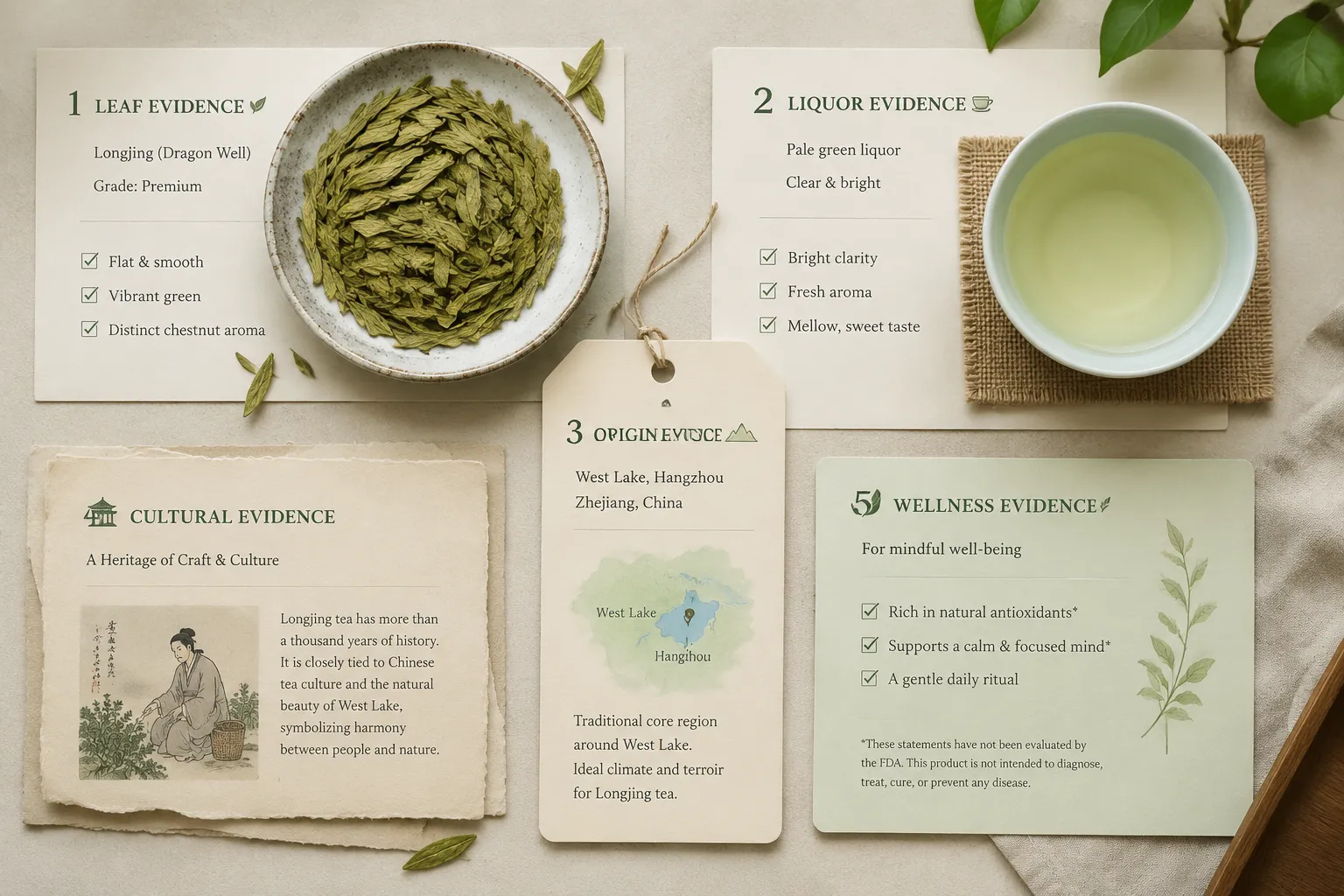
When a Dragon Well description feels convincing, slow it down into five layers.
- First, read the leaf. Flat shape, color, aroma, breakage, and freshness are visible or sensory cues. They help you decide how carefully to brew and whether the tea seems lively.
- Second, taste the cup. Yellow-green liquor, fresh vegetal sweetness, chestnut-like warmth, and bitterness from oversteeping are cup observations. They can support a style impression.
- Third, read the place language. Dragon Well versus Longjing is usually a naming issue; Xi Hu Longjing versus generic Dragon Well is a place-identity issue. West Lake Longjing claims need more than sensory resemblance.
- Fourth, read the cultural language. Legends, famous villages, harvest timing, and prestige words can explain why people care. They do not automatically verify a specific product.
- Fifth, read the wellness language with restraint. Caffeine and general green tea context are fair topics; strong outcome language should not ride on tradition.
This is the central correction: Longjing flat leaves tell only part of the story. A good cup can confirm pleasure, freshness, and brewing fit. It cannot, by itself, settle origin, history, authentication, or health claims.
What the available sources can and cannot support
The source base for this topic is useful but limited. UNESCO can support the broad idea that Chinese tea culture includes processing techniques and associated social practices. FAO can support West Lake Longjing as part of a Hangzhou place-based agricultural and cultural system. NCCIH can support cautious general boundaries around green tea, caffeine, and wellness expectations.
The same source base is weaker for exact protected-origin rules, detailed label procedures, village boundary lists, historical emperor legends, and Dragon Well-specific sensory standards. Commercial sellers, brand stories, videos, forums, and social posts are useful mainly because they show the language readers encounter: authentic, Shi Feng, pre-Qingming, QR code, famous village, legend, scam anxiety, and wellness language. They should not be treated as independent proof.
That limit is not a flaw in the reader’s task. It is the task. Dragon Well tea culture becomes clearer when each claim is placed where it belongs: leaf, cup, place, lore, market language, or cautious health context.
Next time you brew Longjing Dragon Well, note one thing before reading the label again: whether the first cup is fresh, chestnut-like, sweet, or bitter. Then let the sourcing claim stand on evidence beyond the cup.
Sources
Sources and further reading
Reference links are limited to sources considered suitable for public citation in this page.