
Sensory note
Why Chinese Green Tea Is Often Linked With Freshness
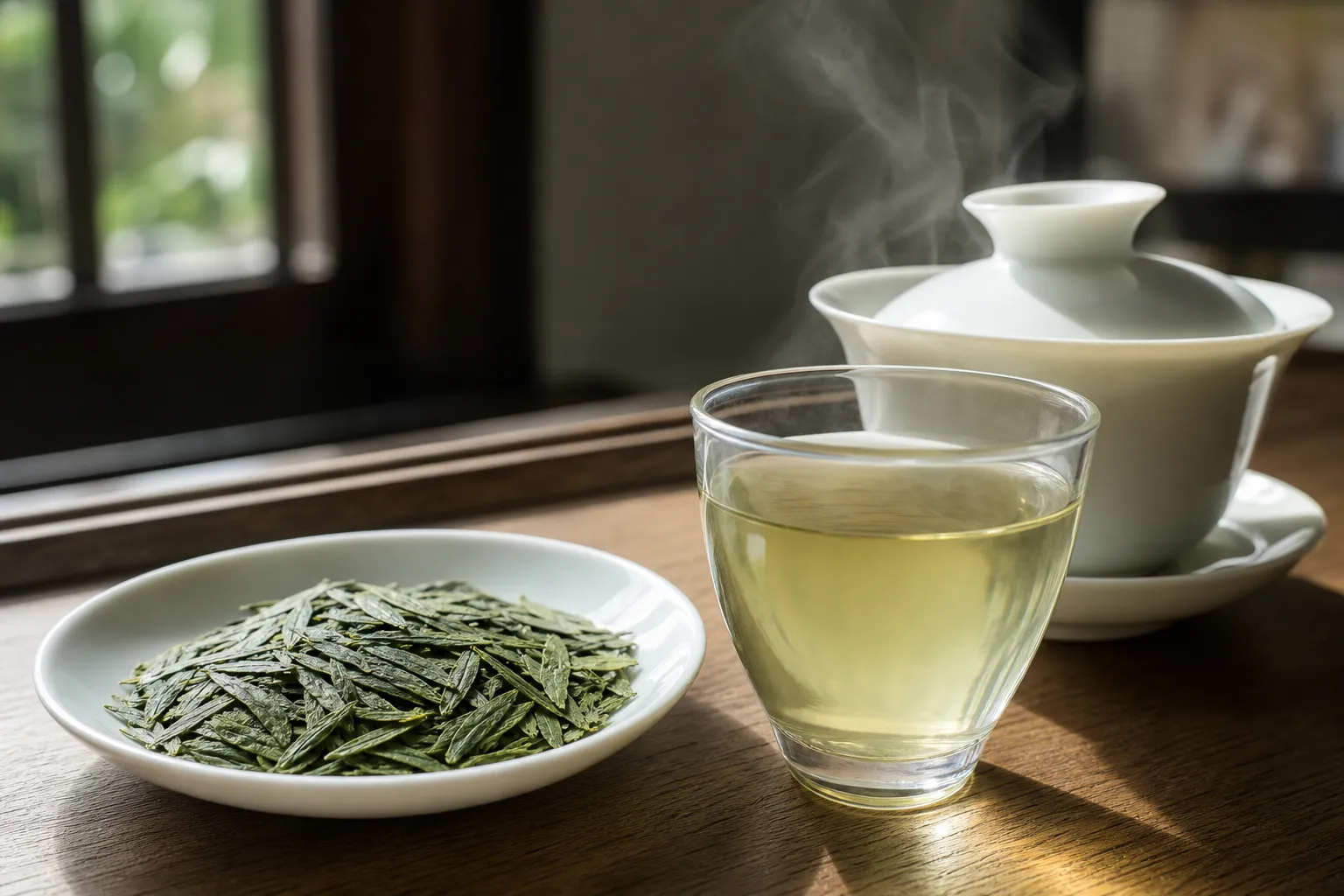
Flat Longjing leaves, pale green liquor, and a lifted dry-leaf aroma all point to the same idea: Chinese green tea is often linked with freshness because drinkers read it through early sensory signs. Chinese green tea freshness usually means a cup that feels bright, clean, and alive in aroma and flavor; it does not automatically prove origin, grade, overall quality, or any particular wellness effect.
The practical answer is simple: freshness is a tasting and buying cue. It may show up as greener-looking leaf, a spring-like aroma, clearer sweetness, and less stale or papery flavor. But storage, brewing temperature, steep time, and the leaf’s original condition all change what the drinker perceives.
upward
Start with the broader guide
Use the broader guide first if you need the full scope before this page.
Freshness Starts With Leaf and Cup
Fresh green tea is often noticed first through smell. When the dry leaf still has lift, the aroma may seem grassy, nutty, vegetal, floral, or gently sweet, depending on the tea. With Chinese green tea, that freshness language often begins at the pouch: the first opening, the warmth of a preheated gaiwan, the steam rising from the first steep.
Appearance can help, but it should not carry the whole judgment. A green or yellow-green leaf, a clear liquor, and a tidy leaf shape may suggest careful handling, but color alone is an imperfect sign. Some teas are naturally more yellow, olive, or muted. A bright-looking leaf can still taste thin; a duller-looking leaf can still brew pleasantly if it was stored well.
Flavor is the stronger checkpoint. Freshness in green tea often feels like a clean first sip: less cardboard, less mustiness, less heavy bitterness, and more of the tea’s intended character. For Longjing Dragon Well, that may mean a gentle nutty-vegetal impression. For other Chinese green teas, the cup may lean grassy, lightly floral, or softly savory. The exact note matters less than whether the cup feels clear rather than tired.
Mouthfeel adds one more clue. A fresh-tasting brew may feel brisk or smooth without seeming flat. If the liquor tastes hollow, dusty, stale-sour, or bitter without aroma, the issue may be age, storage, brewing, or simply a leaf that was not strong to begin with. Read the cup before the claim.
Why New-Season Language Matters
New season green tea is one reason freshness has such a strong pull around Chinese tea. In everyday buying language, a recent harvest sounds appealing because many green teas are valued for delicate aroma and a lively cup. If a tea depends on fresh leaf character, time can matter.
That does not mean every packet described as new is automatically better. The phrase can guide attention, but it does not prove origin, grade, careful storage, or enjoyable flavor. Without stronger documentation for a particular tea, treat new-season wording as a prompt to check the leaf and brew, not as a conclusion.
This is especially important because “fresh green tea China” can mean different things in different buying situations. One seller may be pointing to harvest timing. Another may be using freshness as a broad marketing word. A tea friend may simply mean the cup tastes lively. Those uses overlap, but they are not identical.
A careful buyer can ask
- Does the dry leaf still have a distinct aroma?
- Does the first infusion taste clear, or does it fade immediately?
- Does the seller give concrete storage and handling details?
- Does the tea remain pleasant when brewed gently?
- Does the cup match the style you expected, or only the label?
Freshness language is useful when it leads to observation. It becomes weak when it replaces observation.
Helpful Freshness Cues, With Limits
The most useful green tea freshness cues are sensory, not decorative. They help separate a lively tea from a merely attractive one.
Aroma
Fresh green tea aroma may rise quickly when the leaf meets warm water. It can seem sweet, grassy, chestnut-like, vegetal, or floral. If the tea smells faint before brewing and muted after brewing, that is worth noticing. Still, some teas are naturally subtle, so a quiet aroma is not proof of poor condition.
Leaf condition
Whole or mostly intact leaves give the drinker more to read: shape, color, tenderness, and how the leaf opens after steeping. Broken leaf, dust, and uneven pieces are not always a disaster, but they can make brewing less forgiving.
Liquor color
Green tea color freshness is often imagined as pale green or yellow-green, but clarity matters more than a fixed shade. A clear cup can still vary by style, water, and steep. A cloudy or brownish cup may raise questions, but it should be judged together with aroma and taste.
Flavor and brewing behavior
Fresh green tea flavor usually has definition: a clean opening, a recognizable middle note, and an aftertaste that does not collapse into stale dryness. Water that is too hot, or a steep that runs too long, can make a good tea seem rough. Cooler water and shorter steep time can reveal whether aroma and sweetness are still underneath.
Let the kettle explain some of the bitterness before blaming the tea.
Storage Protects Freshness; It Cannot Create It
Green tea storage freshness is about protection. Once a tea has lost much of its aroma, a better tin cannot rebuild the cup. Storage can slow decline, reduce exposure, and preserve what remains, but it cannot turn a stale leaf into a bright one.
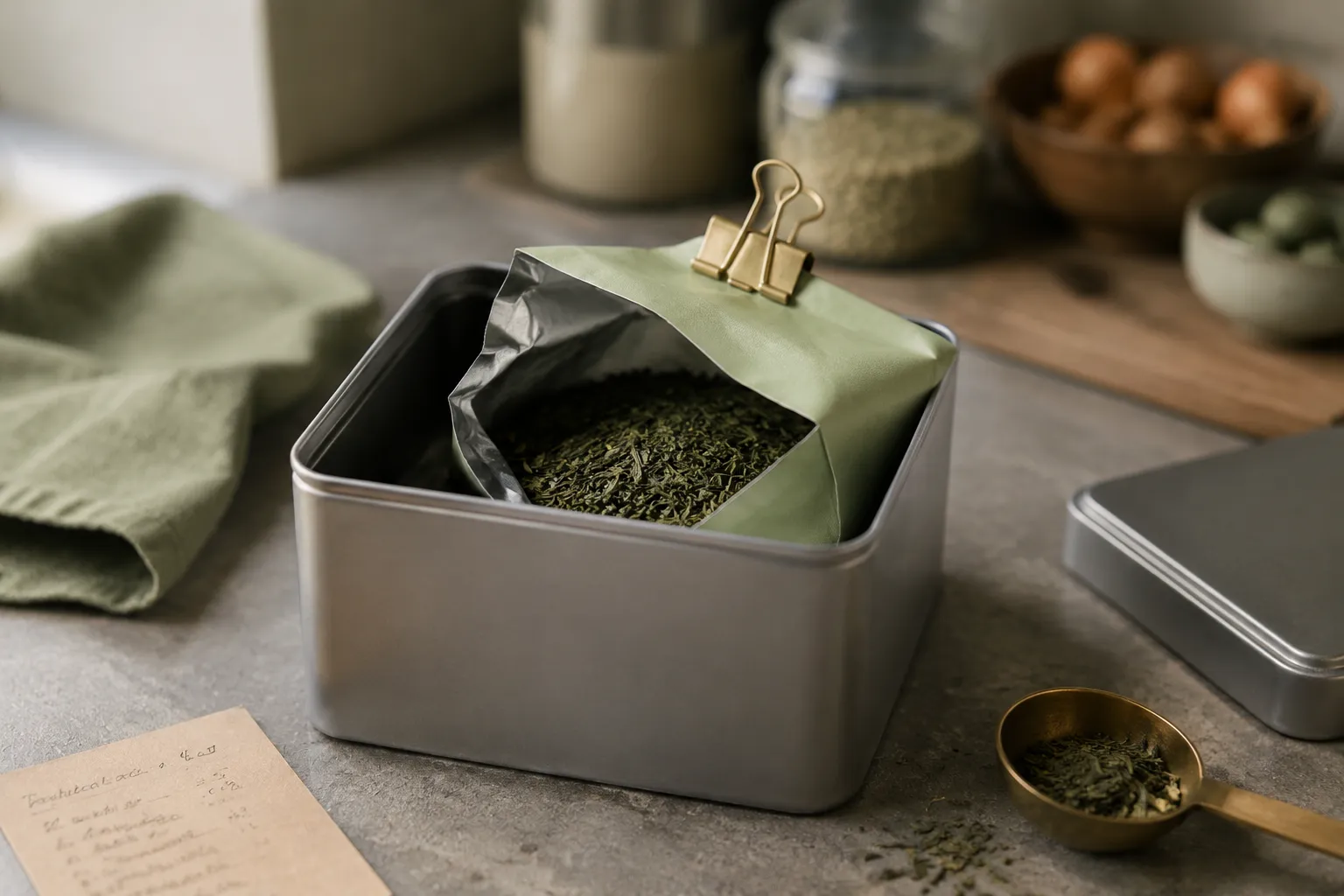
The practical rule is to protect the leaf from air, light, heat, moisture, and strong odors. A closed pouch inside a storage tin is often more sensible than a beautiful jar that lets light in or opens too often. A tea kept near spices, steam, or sunlight may taste older than its label suggests.
Opened tea also changes faster than sealed tea. Each opening brings air and kitchen smell into the packet. This does not mean the tea becomes unusable at once; it means the cup may soften over time. If the first week tasted grassy and sweet, but a later cup seems flat, storage may be part of the answer.
Matcha makes this point easy to see, even though it is not the same as Chinese loose-leaf tea. A fine powder exposes more surface area, so drinkers often notice aroma loss quickly after opening. Loose leaves behave differently, but the lesson carries over: delicate green tea character is easier to protect than to recover.
For Chinese green tea, freshness is not only a harvest idea. It is a chain: original leaf condition, handling, packaging, storage, and brewing. A weak link can dull the cup.
Freshness Culture Needs a Careful Reading
Chinese tea freshness culture is a real search interest, but it should be handled carefully. It is fair to say many drinkers associate green tea with early, lively, aromatic cups. It is not fair to turn that broad association into a rigid rule about every Chinese tea, every region, or every buyer.
Chinese green tea is not one single flavor. Longjing Dragon Well, curled green teas, needle-like green teas, and other styles can differ in leaf shape, aroma, sweetness, and body. Some are delicate; others are more robust. A freshness lens helps, but it should not flatten variety.
There is also a difference between cultural preference and sensory proof. A community may value a fresh-tasting cup, a seller may highlight new-season tea, and a drinker may prefer spring-like aroma. Those are useful contexts, but the cup still needs to be brewed and tasted.
This is where freshness can become misunderstood. A reader may assume fresh means expensive, authentic, rare, or automatically better for daily wellness. Those jumps go beyond what the leaf can show. Freshness can support a better-tasting green tea experience, but it cannot prove every claim attached to a packet.
Green tea contains caffeine, and some drinkers discuss it in relation to routine or alertness. But freshness is mainly a sensory and storage topic here. A fresher-tasting tea does not guarantee a particular personal effect, and health questions belong outside a tasting note.
When a Tea Tastes Less Fresh Than Expected
A dull cup is not always a bad purchase. Sometimes the brew is too concentrated. Sometimes the water is too hot. Sometimes the leaf-to-water ratio is heavy, and the tea turns bitter before its aroma appears. Before deciding the tea has lost freshness, change one variable.
Start with gentler water. Use a slightly lower brewing temperature and a shorter steep, then smell the wet leaf before sipping. If the aroma opens and the bitterness softens, the tea may simply need a lighter hand. If the cup remains flat, dusty, or stale across several careful steeps, storage or age may be more likely.
Next, check the dry leaf again. Does it smell like tea, or mostly like packaging, cupboard, paper, or nothing at all? Does the brewed leaf look exhausted after one infusion? Does the aftertaste disappear quickly? These are not laboratory tests, but they are practical green tea sensory cues a reader can use at home.
Finally, compare expectation with style. A delicate Chinese green tea may not taste as grassy as sencha, and it should not be judged only by another country’s flavor profile. A Longjing cup may feel soft and nutty rather than sharply green. Freshness is not the same as intensity.
The better question is not “Is this tea fresh in the abstract?” It is “Does this leaf still give a clear aroma, a clean cup, and a flavor that matches its style?”
A Simple Freshness Check Before You Trust the Label
Before buying or brewing around a freshness claim, use a compact check:
- Smell the dry leaf before and after warming the vessel.
- Look for leaf condition, but do not judge by color alone.
- Brew gently first, then adjust heat or time if the cup feels thin.
- Notice whether the flavor is clean, stale, harsh, or flat.
- Treat new-season language as a cue to verify, not a promise.
- Store opened tea away from air, light, heat, moisture, and strong odors.
This keeps Chinese green tea freshness useful without making it too large. Freshness can explain why a cup feels lively, why new-season tea attracts attention, and why storage changes the drinking experience. It cannot prove origin, overall quality, or wellness outcomes by itself.
The next time a Chinese green tea is described as fresh, do not start with the label. Warm the leaf, smell the steam, brew lightly, and let the first cup show what is still alive in the tea.